

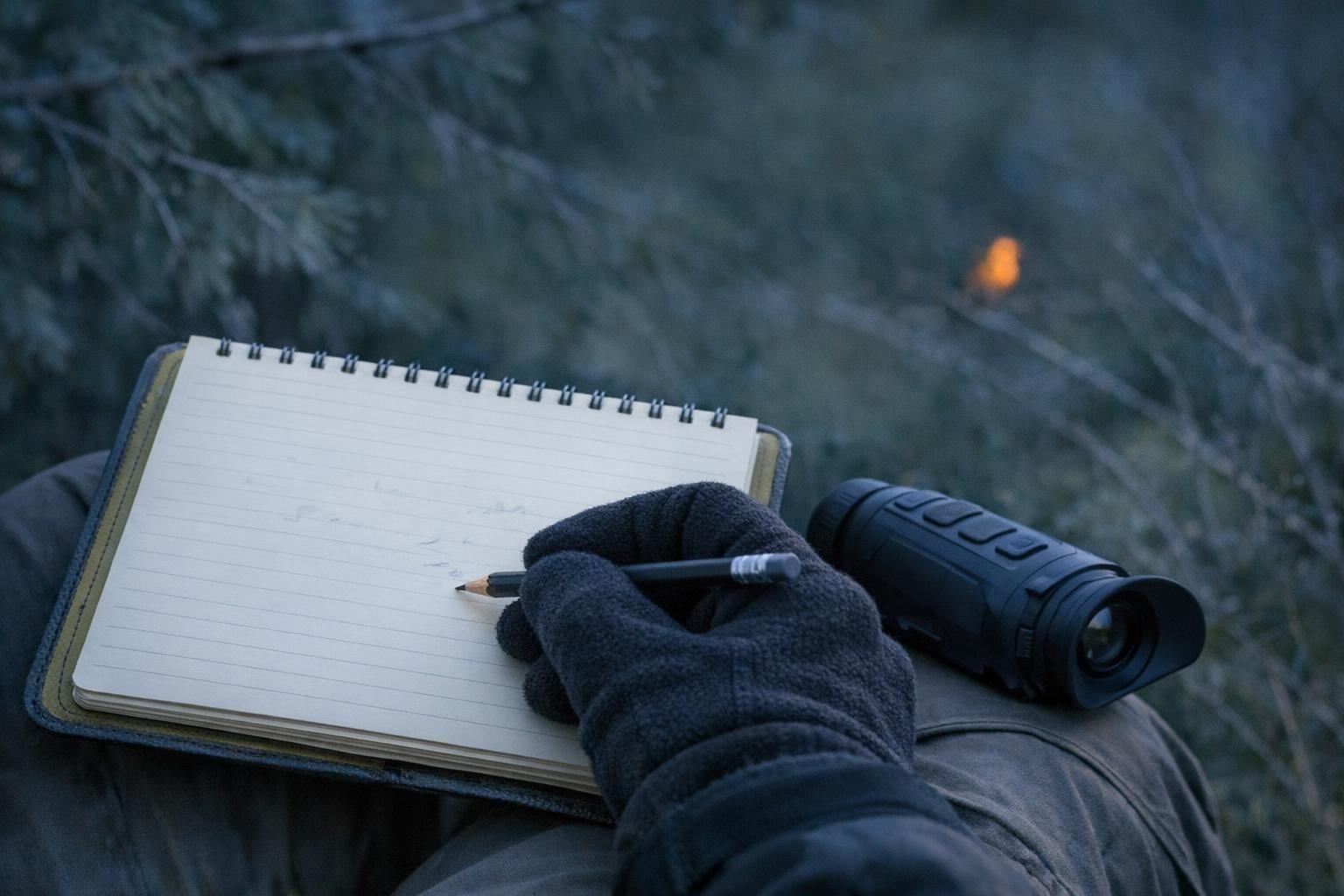
Birds can be found using thermal imaging equipment. This is ideal for species that take refuge in dense covers and it allows the birdwatcher to spot species that he would have otherwise failed to spot. In order to be able to observe birds using thermal imaging equipment it is important to minimize the disturbance of the roosting birds. This is very important and with a few simple strategies you can ensure a very successful outing while keeping the welfare of the birds paramount.
Set Clear Objectives for Your Observations
Before you go outside you should establish what your goals for the session are. These could be to confirm activity at a particular roost or to study the behavior of birds at a roost during different times of day. Once you have set your self these goals it should prevent you from being distracted by every bird you see.
Don't go into your outing without first setting up an observation plan, outlining what you hope to learn from your birdwatching. Remember to include the location, the date of your outing, the time that you arrived and the time that you left as well as any weather that you encountered. Also make sure that if you are in an area with sensitive species that you do not provide too much detail of the habitat that you have been observing and try to avoid giving out the GPS coordinates of the site(s) that you have been to in order to write up your reports afterwards.
Set a stopping rule for yourself. For example, you might say that after a given time you will stop looking for birds at a site in order to determine whether or not it is occupied by roosting birds. Alternatively, you might decide to stop looking after you have made a single complete scan of your viewpoint.
An example of a useful observation would be: "A warm shape in a dense patch of foliage but no sign of movement. Species unknown". This way, rather than making a potential identification based on limited information you can go back to the site at a later date to carry out more observations in daylight.
Choose Your Observation Spot Thoughtfully
Staying at a safe distance is only one part of bird watching in an ethical way. Taking into account the path that birds normally take through the area as well as your own body profile, how much light you are exposing yourself, any noise you may be making and the frequency of your visits to the roosting area are also very important to consider when choosing an observation point. Look for positions that allow you to observe from within the natural environment without causing disturbance to birds flying through the area.
Stick to the trails. These can provide the best access to your target site while keeping you out of sensitive areas and preventing you from disturbing birds traveling along particular routes through natural habitats. Note that even with the best view points available along paths through natural habitats your view will at times be obscured by trees etc., and you must include these observations in your total data.
Also be aware of your use of light. Birds can be spooked by sudden bursts of light so avoid using flashlights to verify a thermal reading, unless you have good reason to believe it may be safe to do so. If you are going to use lights to observe a roosting site, try and use them in a way that will have the least impact on the birds. Make sure that all your party members are also aware of the need to use lights responsibly.
Finally, when you are out in the field with other birdwatchers, remember to take one person to note down your observations, and make sure you have silent signals for communication with each other. It can cause quite a disturbance when there are so many people focusing on one subject. So be a responsible solitary observer, equipped with the proper tools for the job.
Fine-Tune Your Note-Taking Approach
Designing an adequate set of notes, with appropriate space for refining details over time, is an essential component of an effective bird watcher. Logs should record the time, general location of the observation, suspected subject, bird's behavior, and degree of confidence in ID of species.
Just list the behaviors. Try to limit your note taking to observations of your subject's behavior, and give details of how long you watched them for. Avoid assigning identities to your subjects too early. The comment 'Stationary heat signature with minimal head movement in cover' is far more valuable than a simple identification of species.
As with all species identification, record your confidence in the species identification separately to this. Using low, moderate or high would be a simple way to classify your level of certainty with your identification, and this should be based upon your perception of the images rather than your overall experience of the area. A clear image of an animal does not necessarily mean that you have identified the species correctly.
Recording additional details such as habitat type, bird's direction of travel, background sounds and relevant weather will only serve to enhance your observation and provide useful information for later interpretation. In most cases there will be little need to revisit the site for further data collection.
Exercise Caution in Your Certainty
The very fact that thermal technology reveals contrast not visible to the naked eye means there is potential for misinterpretation. A hot 'animal' image could be any number of creatures and indeed could be a heated branch or even the ground. The interpretation of what has been observed must take into account the limitations of the display being viewed.
Display contrast can be manipulated by changing display settings. When evaluating evidence from thermal images to make a determination, concentrate on the overall shape, posture, movement within the surrounding environment and any sounds that may have been detected. If evidence is lacking to make a positive determination then that is sufficient to make a note. For example, "Possible roosting bird; species undetermined".
Verify or confirm later. It is not necessary to return to the same spot again and again. Verification can be done on a later date in daylight or using other reliable means of reference to verify previous observations.
Reflect on Your Find and Methods
Finally, when the outing is over, review your notes to think about what you have learned and about the impact your outing may have had on the roosting birds. Be able to identify patterns in your behavior, such as moving in when visibility is poor or repeatedly returning to the same location.
Be sure to include only the information that others need to understand your findings and it is best to keep sensitive information about specific roost locations (especially revisit locations) confidential unless absolutely necessary. Also, protect wildlife and heed the current relevant laws and regulations regarding the protection of wildlife at roost sites before you go there or distribute data about birds that you have observed there.
The value of any birding notes, whether created using thermal birding technology or not, is usually directly proportional to their brevity and accuracy. Any recorded information, especially corresponding images, should present an honest, definitive account of the bird(s) observed, including all observable actions and vague uncertainty. Note the specifics of the site where the observations were made, as well as the techniques that were used to arrive at the conclusions that are recorded.