

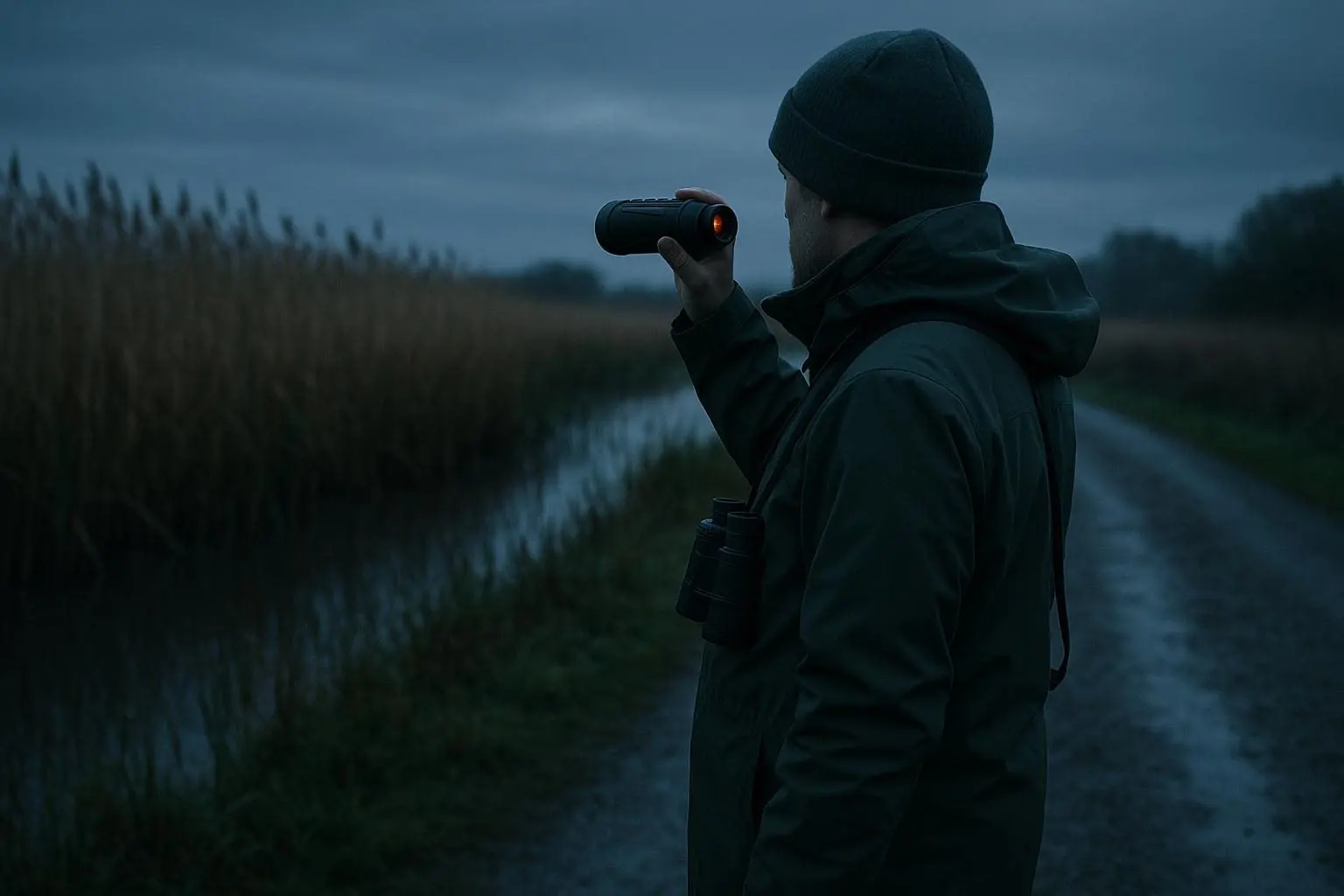
At the edge of a reedbed after sunset a thermal viewer may reveal a shape moving where the naked eye sees only black stems and water. That can help a birder activity follow a flight path or avoid walking into a roost. It can also create confidence: a glowing outline is not automatically a bird and a visible bird is not automatically identifiable. The useful question is which decisions thermal imaging improves-and where optics, sound and habitat knowledge must take over.
What the heat image actually tells you
A thermal camera detects differences in radiation and displays them as variations in brightness or colour. It does not see through darkness like a headlamp. Produce a hidden version of a normal photograph. A bird may appear as a shape against a cooler background especially when moving or crossing open ground.
That contrast can help locate a bird in leaf litter track movement along a hedge or watch a nocturnal species leave a roost without shining a beam at it. It may also reveal activity patterns: repeated flights from one patch several animals using the edge or a stationary shape that becomes active when disturbance stops.
The image is most useful when temperature differences are clear. Wet vegetation, warm rocks, sun‑heated surfaces and sheltered cavities can complicate the scene while weather and dense foliage may reduce or break up the outline. Treat the display as a map of heat patterns, not a picture of an animal.
Why identification remains a job
Thermal birding is generally better at detection than identification. Thermal imaging can show that something warm is moving through a habitat but not whether it is a small owl, a mammal, a low‑flying bird or a background object retaining heat. Size, posture, flight style and timing can narrow the possibilities without settling an identification.
Feather colour, plumage pattern, eye colour and fine bill shape are largely absent. Silhouette can also mislead when a bird faces away crouches, carries prey or is partly hidden. A large bird viewed at a distance may resemble a smaller one and digital zoom can enlarge uncertainty rather than detail.
The soundscape and habitat remain important. Listen for calls, wing noise and contact notes. Note the height and direction of movement its response to wind and whether it behaves like a roosting, feeding or migrating individual. If a record matters, confirm it later with optics, audio, a trusted field guide or an appropriately qualified reviewer. A thermal image can support an observation; it should not manufacture certainty.
Choosing equipment by the decision you need to make
Start with the field problem, not the impressive specification. A compact thermal monocular may suit someone who wants to scan a path find movement in a field and then switch to binoculars or a scope. It is easy to carry and leaves one hand free. Viewing through one eye for long periods can make comparison with the surrounding habitat less intuitive.
A thermal binocular‑style device may be more comfortable for observation and tracking but it can be heavier more expensive and more tempting to use continuously. A phone‑mounted thermal attachment may suit use or documentation; check compatibility, battery dependence and handling in cold or damp conditions.
For bird identification a dual approach is usually more useful than imaging alone: detect with thermal equipment then use visible optics or listen from a responsible distance. When comparing models check clarity at the distances you actually use controls with gloves focus behaviour, battery replaceability, weather resistance and whether recordings retain context for later review. A broad field of view helps scanning; a detailed image helps examine a known subject. Neither replaces fieldcraft.
Common mistakes that undermine observations
The first mistake is treating every bright shape as an animal. Scan change your angle and look for consistent movement. A warm fence post does not alter its posture when the wind changes though heat shimmer and vegetation can still confuse the reading.
The second is using magnification too early. Locate the subject at a view observe its direction and surroundings then magnify briefly if needed. A cropped image makes it harder to judge scale, habitat or whether the subject is moving.
Night viewing is not automatically less intrusive. A thermal device may avoid light but footsteps, voices, repeated approaches and prolonged presence can still alter behaviour. Treat roosts, nests and feeding sites with restraint. Do not enter cover simply because the screen suggests something is there.
Avoid recording every sighting without notes. Time, weather, habitat, viewing angle and behaviour may provide identification value than a short featureless clip. Keep the file for an unusual observation and label uncertainty honestly.
A responsible field check before you scan
Use this check before observing:
– Is the location lawful to access and have you checked local restrictions?
– Can you remain quiet and stable than following the subject?
– Could your presence disturb a roost, nest, feeding group or resting animal?
– Do you have an identification method, such as sound or visible optics?
– Will you stop if behaviour changes the subject retreats or conditions become unsafe?
Rules on access, protected species, recording and equipment can change, so consult official guidance, for the relevant land and jurisdiction. Landowner permission may also be necessary even where wildlife is not protected by a rule.
The best owner of a camera is not the person who uses it longest but the person who knows when a short quiet scan adds information, when conventional observation is better and when leaving the habitat undisturbed is the most accurate decision. Used that way thermal imaging extends a birders awareness without pretending to replace identification, patience or care.